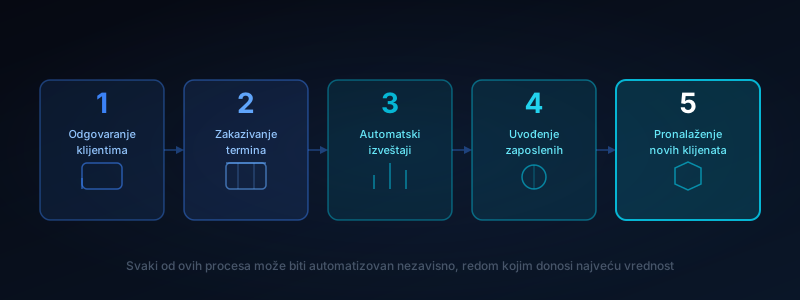
1. Responding to incoming client inquiries
This is the most universal automation candidate regardless of industry. Every company receives repetitive inquiries: questions about pricing, availability, procedures, order status, or simply requests for information that's already on the website or in your documents.
An AI agent trained on your materials can answer 70 to 85% of these immediately, without any employee involvement. The rest get escalated with the full conversation context.
Measurable result: average response time drops from several hours to under 30 seconds. Customer service staff focus on complex situations that require judgment.
2. Scheduling and appointment coordination
Coordinating appointments between multiple parties is one of the most friction-heavy processes in business communication. A 15-email thread to agree on a meeting time is a reality for many teams.
An automated scheduling system accepts requests, checks availability in real time, proposes times, and confirms the booking, all without manual intervention. Reminders and cancellation handling are part of the same system.
Measurable result: elimination of 3 to 5 email exchanges per booking. For companies with 20 or more appointments per week, that adds up quickly.
3. Generating regular internal reports
Weekly, monthly, and quarterly reports are still done manually in most companies. Someone pulls data from multiple systems, copies it into a spreadsheet or presentation, formats it, and sends it. That process can take 2 to 8 hours per cycle.
An automated system pulls data from defined sources, generates the report based on your template, and delivers it to the relevant people on schedule. Everyone gets the same accurate data at the same time.
Measurable result: elimination of 4 to 10 working hours per month per report cycle, plus elimination of copy-paste errors.
4. Onboarding new employees
Onboarding is a process that repeats with every new hire and typically consumes time from both HR and managers. Same documents, same questions, same introduction to tools and procedures for every new team member.
Automated onboarding guides new employees through a structured program: company introduction, tool access, procedure walkthroughs, and clear tasks for the first 30 days. An AI assistant is available for questions 24 hours a day.
Measurable result: time to full productivity reduced by 30 to 50%. HR team freed from repetitive onboarding tasks.
5. Identifying and reaching out to potential clients
This is the only process on this list that doesn't just cut costs but directly increases revenue. An automated lead generation system runs continuously, 24 hours a day, without any variation in quality between Monday and Friday.
The system identifies companies and people matching your ideal customer profile, starts personalized outreach, and qualifies interested parties before passing them to your sales team. Your team enters the conversation only after the lead is already warmed up.
Measurable result: higher conversion rates because the team works on qualified opportunities. Sales team freed from cold outreach with low return.
Which order to tackle them in
The right prioritization depends on your current operational profile, but the general rule is:
- If you have a problem with response speed to clients: start with inquiry handling
- If your team is losing time to coordination: start with scheduling
- If managers are spending too much time on reporting: start with reports
- If sales are stagnant despite a good team: start with lead generation
The right approach is to start with one process, measure results, and then expand the system. Trying to do everything at once is a guaranteed path to a poor implementation of all of it.