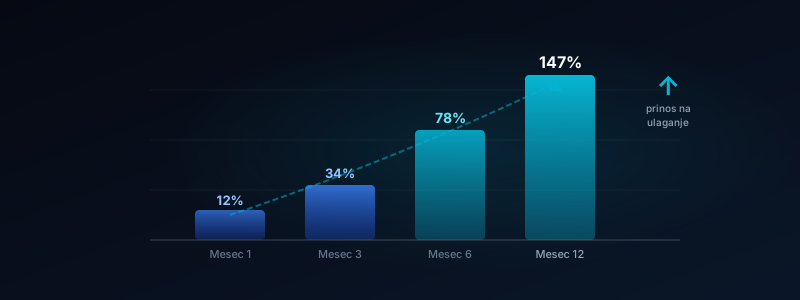
Three categories of benefit: direct, indirect, and revenue growth
ROI from AI automation comes from three sources that companies often count only partially or one at a time.
1. Direct labor costs
The most straightforward category to measure. How many hours of your team's time currently go to tasks that can be automated, multiplied by the average hourly cost of those employees.
Example: 5 employees spend an average of 15 hours a week on repetitive tasks. Average gross hourly rate is $25. That's $7,500 a month in direct labor costs on tasks AI could take over.
2. Indirect benefits
These are harder to quantify but no less real:
- Fewer errors: every mistake has a correction cost and potential client impact. AI systems have a consistently lower error rate on repetitive tasks.
- Faster response time: shorter response times directly affect client satisfaction and retention.
- Availability outside business hours: a system that runs 24/7 catches opportunities that would otherwise be missed.
- Scalability: an AI system can handle 10x the volume without a proportional increase in cost.
3. Revenue growth
When your sales team gets better-qualified leads, customer service responds faster, and onboarding is systematic, that translates into higher revenue. This category is the hardest to project precisely but is often the largest over time.
A simple formula for projecting ROI
Basic formula for AI implementation ROI projection:
Monthly savings = (Automated hours/month × Average hourly cost) × Automation rate
Payback period (months) = Implementation cost / Monthly savings
This formula gives a conservative ROI that only accounts for direct labor costs. The real value is always higher when you include indirect benefits and revenue impact.
Real numbers by company size
Based on implementations we've done, here are rough projections:
- Company with 5 to 15 employees: implementation $3,000 to $6,000, payback period 3 to 6 months, annual savings 2x to 4x the implementation cost
- Company with 15 to 50 employees: implementation $6,000 to $18,000, payback period 4 to 8 months, annual savings 3x to 6x the implementation cost
- Company with 50 or more employees: implementation scoped to volume, payback period 5 to 10 months, long-term value multiple times the cost
What to watch for when evaluating a potential partner
Any serious AI implementation partner should give you before you sign:
- A clear list of which processes are being automated and the projected impact of each separately
- A methodology for measuring system performance in production
- Realistic savings projections based on your specific data, not industry averages
- Defined KPIs that both teams will track together
If a partner can't provide this before signing, that's a clear signal the assessment wasn't done seriously.