What you actually don't need
Let's start by clearing things up. To implement and use an AI system in your business, you don't need:
- An internal IT team or software engineers
- Dedicated server infrastructure
- Technical knowledge from your management
- Specialized training for employees to manage the system
- A months-long project before you see the first results
These assumptions come from the era of software that was installed on your own servers and needed a dedicated administrator. Modern AI infrastructure works differently.
What you actually do need
Three things are required for a successful AI implementation:
- A clearly defined business problem. Not "we want AI," but "we have exactly this problem that costs us this much time." The more precisely defined the problem, the faster and more effective the solution.
- Existing data in some format. Documents, procedures, email archives, CRM data. They don't need to be perfectly organized. They just need to exist.
- One person on the team as a point of contact. Not a developer. Someone who can identify when the system gives a wrong answer and verify whether a knowledge base update is correct.
Step by step: from idea to live system
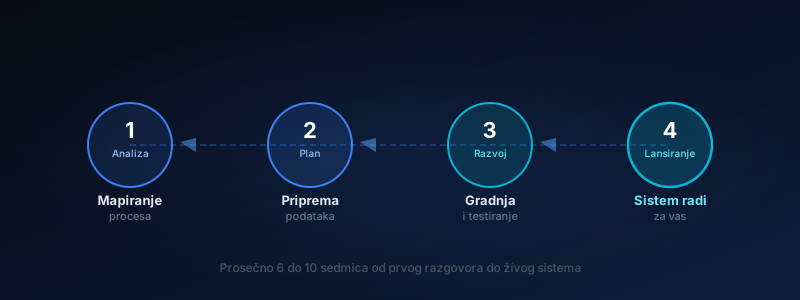
A realistic timeline for a first AI implementation in a company with no prior experience:
Weeks 1 and 2: Analysis and definition
Together with the implementation partner, all relevant processes are mapped out, three to five areas with the highest automation potential are identified, and one or two areas are selected for the first project. The focus is on quick wins rather than an ambitious all-encompassing rollout.
Weeks 3 and 4: Data preparation and architecture
The partner collects and processes your internal documents. You verify that the documents are current and complete. The system architecture and integration points with your existing tools are defined.
Weeks 5 to 8: Development and testing
The system is built iteratively. During development, you test real scenarios and give feedback. No surprises at the end of the process because you're involved throughout.
Weeks 8 to 10: Launch and monitoring
The system goes live gradually. Metrics are tracked, the partner steps in on any deviations from the defined behavior, and you take over operational control through a straightforward interface.
5 questions you must ask any potential implementation partner
Before hiring anyone for AI implementation, these questions are non-negotiable:
- Who manages the system after implementation, and what technical knowledge does that require?
- How does updating the knowledge base work when procedures change?
- What happens when the system gives a wrong answer, and who is responsible for the correction?
- How is our data protected, and can the partner access it without our permission?
- What is the SLA for support, and what's the turnaround time for resolving production issues?
A serious partner has clear answers to all of these before the conversation moves to pricing. If the answers come after signing, that's a bad sign.
Where to start: recommendations for a first project
Based on experience with implementations across companies of different sizes and industries, the recommendation for a first AI project almost always falls into one of two profiles:
- If you have a problem with response time to client inquiries: an AI agent for first-line customer communication. Fast ROI, visible results immediately, and relatively low implementation complexity.
- If you have a problem with internal reporting or HR questions: an internal assistant with a knowledge base. Fast implementation, immediate improvement in employee experience, and easily measurable results.
In both cases, the first project should be focused and measurable. Don't try to solve everything at once.