What actually counts as a repetitive task
Repetitive tasks aren't just entering data into a spreadsheet or printing reports. They're any activity that follows a predictable pattern, doesn't require a fresh creative judgment each time, and could be described by a set of rules. In practice, this includes:
- Answering the same client questions that come in every day
- Routing requests to the right person or department
- Generating regular reports from data that already exists in your systems
- Scheduling and coordinating meetings between multiple parties
- Copying data from one system into another
- Tracking task status and sending reminders
- Formatting and sending standard documents and contracts
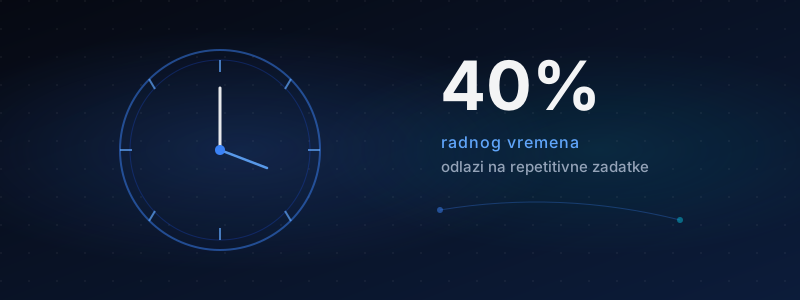
Each of these takes time from your team every single working day. On its own, it might seem minor. Across a month and a team of 10 people, it becomes a real number.
The math on lost time
Let's run a concrete calculation. Take a company with 10 employees where each person spends an average of 12 hours a week on repetitive tasks, with an average monthly gross salary of $4,000.
(10 employees x 12h/week x 52)
(at 65% automation rate)
This isn't money wasted on something unnecessary. It's money spent on tasks that have an alternative. The difference isn't whether you'll pay, but who: employees doing tasks that could be automated, or an AI system that handles them faster and more accurately.
Where the loss is highest by industry
Analysis by industry shows different levels of exposure to repetitive tasks:
- Service firms and agencies: project coordination, client reporting, invoicing. Automation potential: 60 to 75%
- Sales teams: CRM data entry, tracking open proposals, sending follow-ups. Potential: 55 to 70%
- HR departments: answering employee questions, onboarding admin, tracking absences. Potential: 65 to 80%
- Customer service: answering standard inquiries, routing requests, sending status updates. Potential: 70 to 85%
- Finance and admin: generating reports, tracking payments, reconciling data. Potential: 50 to 65%
Why companies have been ignoring this cost for years
Three reasons this cost stays invisible on financial reports:
- The costs are buried in payroll. Salary is paid without being broken down by task category. Nobody sees a line item that says "$400 spent answering repetitive queries."
- The alternative used to look complicated. A few years ago, implementing AI required a specialized team and serious infrastructure. That's no longer the case.
- Things are working, so why change them. The status quo always has inertia. But "working" and "optimized" are two fundamentally different things.
"The question isn't whether your team can do these tasks. The question is whether they should have to."
Next step: calculate your specific numbers
General estimates are useful for understanding the scale of the problem, but decisions are made with real data from your organization. The Quantex calculator on the homepage takes your specific parameters and gives you a rough savings projection. For a precise estimate that accounts for your specific processes and identifies exactly which areas have the most potential, a 45-minute conversation is enough.