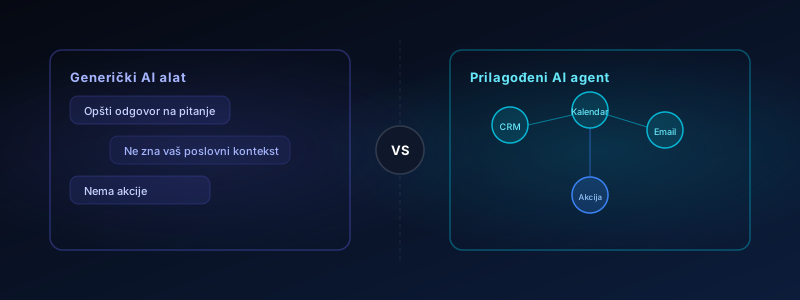
ChatGPT: a general model with no knowledge of your business
ChatGPT is a general-purpose language model. It was trained on a massive set of publicly available text from the internet, books, and various other sources. That makes it capable of a wide range of tasks: writing, translation, explaining concepts, analyzing text.
But there's a fundamental limitation: ChatGPT knows nothing about your business. It doesn't know who your clients are. It doesn't know your pricing. It doesn't know your procedures. It doesn't know the context of the conversation a potential client had with your team last week. Every conversation starts from zero.
This isn't a flaw in ChatGPT. It's the result of what it was designed to be: a general assistant for general tasks.
AI agent: a system with context and autonomy
An AI agent is a different architecture with a different purpose. Here are the key differences:
- Specialized context: the agent is trained or fine-tuned on your company's data. It knows your services, procedures, history, and business logic.
- Autonomous action: the agent doesn't just answer questions, it takes actions: book an appointment, update the CRM, route a request, generate a document.
- Integrations: the agent is connected to your systems. It can access real-time data, check availability, pull a client's history.
- Memory: it remembers context through a conversation and can track multi-step processes over time.
A concrete example: the same question, completely different answers
Imagine a potential client asks: "How much does your service cost for a company of 20 people, and how long does implementation take?"
ChatGPT response
Gives generic information about what AI implementation typically costs on the global market, because it knows nothing about your specific pricing and terms.
Your AI agent response
Pulls your actual pricing for that category of company from your knowledge base, explains what's included in the package, mentions a typical implementation timeline based on similar past projects, and offers to schedule a demo call. All within 3 seconds, at 2am if needed.
"The difference isn't in the intelligence of the AI system. It's in what the system knows about your specific context."
When to use which approach
This isn't a question of better or worse. Both have their place:
- ChatGPT and similar tools are excellent for internal use by employees for writing, research, text analysis, and generating ideas. There, you're using the generality as an advantage.
- Custom AI agents are necessary anywhere the AI system needs to communicate with clients or colleagues on behalf of your organization, take actions inside your systems, or make decisions based on your specific rules.
What this means for your business
If you tried ChatGPT or a similar generic tool and concluded that AI isn't useful for your business, that conclusion was drawn from the wrong experiment. It's like trying a general encyclopedia as a replacement for an experienced salesperson and concluding that books don't help with sales.
A custom AI agent that knows everything your most experienced employee knows, available 24 hours a day, without fatigue-driven errors, is a fundamentally different tool from a generic chatbot.