The problem: your company's knowledge is locked away
Employees who don't know the answer to an internal question do one of two things: ask a colleague or search through documents. Both approaches take time. Asking a colleague breaks the focus of two people. Searching documents often doesn't produce an answer because employees don't know where to look or the documents aren't up to date.
HR spends a significant portion of the working day answering the same questions over and over: how many vacation days do I have, what's the process for sick leave, where do I find the expense form...
This isn't a trivial problem. In a company of 20 employees, even 30 minutes a day lost to searching for internal information is 100 hours of lost productive time per month.
What an internal AI assistant actually is
An internal AI assistant is a software system trained exclusively on your company's documents and data. It knows the content of your policies, procedures, process descriptions, contact lists, and all other internal materials you've given it to work with.
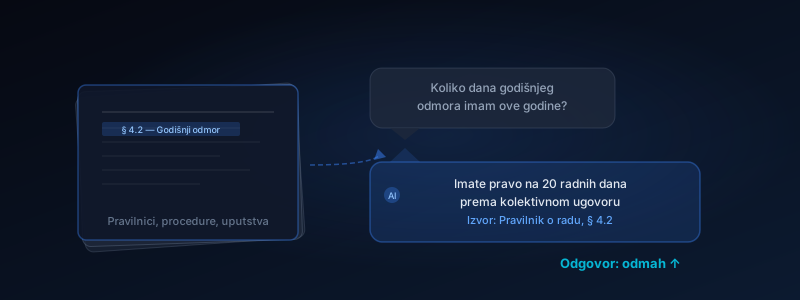
Employees ask questions in natural language, exactly the way they'd ask a colleague. The assistant searches its knowledge base and gives a precise answer with a reference to the source, when relevant.
The difference from a regular document search engine is contextual understanding. A search engine looks for keywords. An AI assistant understands what you're asking and responds in complete sentences, not a list of documents to sift through.
Concrete use cases
Here are typical scenarios from companies using internal AI assistants:
- A new hire asks the assistant: "What's the process for getting access to the systems I need?" The assistant gives the steps, the contact person, and the forms to fill out, all from the onboarding documentation.
- An employee asks: "What's the deadline for submitting the monthly expense report?" The assistant responds with the exact date from the finance department's procedures.
- A manager requests: "Give me a summary of the key metrics for the marketing team from last week." The assistant, integrated with analytics systems, generates a brief report.
- HR doesn't need to answer "How many vacation days do I have" because the assistant answers each employee directly based on their status and the employment terms.
Particular value during onboarding
Onboarding new employees is where an internal assistant delivers disproportionately high value. New hires have an enormous number of questions in their first few weeks. None of those questions are dumb, but collectively they drain the time of experienced colleagues and HR.
The assistant takes over as the first response to all of these questions. New hires can ask without embarrassment, at any time, without worrying they're interrupting someone. This accelerates time to full productivity and improves the experience in those first critical weeks.
The connection to automated reporting
The internal assistant can be extended to automated report generation when integrated with your business systems. Instead of a manager manually collecting data and formatting a report, the assistant does it automatically on a defined schedule or on demand.
This is particularly valuable for companies where managers spend 2 to 4 hours a week reporting up to senior management or owners. Automating that process gives managers that time back to actually make decisions.