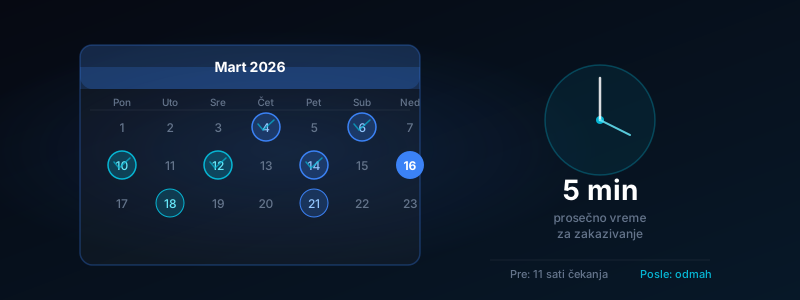
Why this happens and why it's not a motivation problem
Your team isn't indifferent to clients. The problem is structural. Scheduling requests come in at irregular intervals throughout the day, and sometimes outside business hours. When an employee isn't available at the moment the request arrives, the reply gets delayed. At that point, the client is already sending the same request to your competitors.
Whoever replies first gets the conversation. Whoever gets the conversation keeps the advantage.
This isn't a problem solved with motivational training or better time management. It requires an infrastructure solution.
What happens in those 11 hours
Picture a typical scenario. A potential client googles a service at 8pm, finds your website, fills out a contact form or sends an email. Your team is off for the evening. Your reply arrives the next morning at 9. In the meantime:
- The client contacted two or three competing businesses
- One of them had an automated system that replied immediately
- The conversation has already started with a competitor
- The psychological momentum is gone. Your reply arrives late in a race where you're already behind.
The solution: a system that doesn't wait for your team
The automated scheduling system Quantex implements works as a first-line communication layer that never sleeps. When a request comes in, the system responds immediately, collects the necessary information, checks availability against your live calendar, and offers appointment slots. The client goes through the entire booking process without any waiting.
Your team shows up to the scheduled appointment with full context about who the client is and why they're coming.
Sync with your existing calendars
The system doesn't create a parallel appointment record alongside yours. It integrates directly with your Google Calendar, Outlook, or Apple Calendar and reads availability in real time. It will never offer a time slot that's already taken, and every booking appears in your regular calendar immediately.
Updates are two-way: if you block time in your calendar, the system sees it right away and stops offering those times to clients.
Reducing cancellations and no-shows
Automated reminders are a standard part of the system. Clients receive a confirmation immediately after booking, a reminder 24 hours before the appointment, and optionally a reminder 1 hour before. Each reminder offers the option to reschedule if the time no longer works.
This improves show rates and reduces situations where you're prepared and the client simply doesn't appear. Businesses using automated reminders typically see 30 to 40% fewer no-shows.